Exploring procedural narrative generation in text-based adventures through variable dialogue weighting systems and memory state tracking that creates personalized story arcs
Written by Petra Carter · Aug 11, 2026
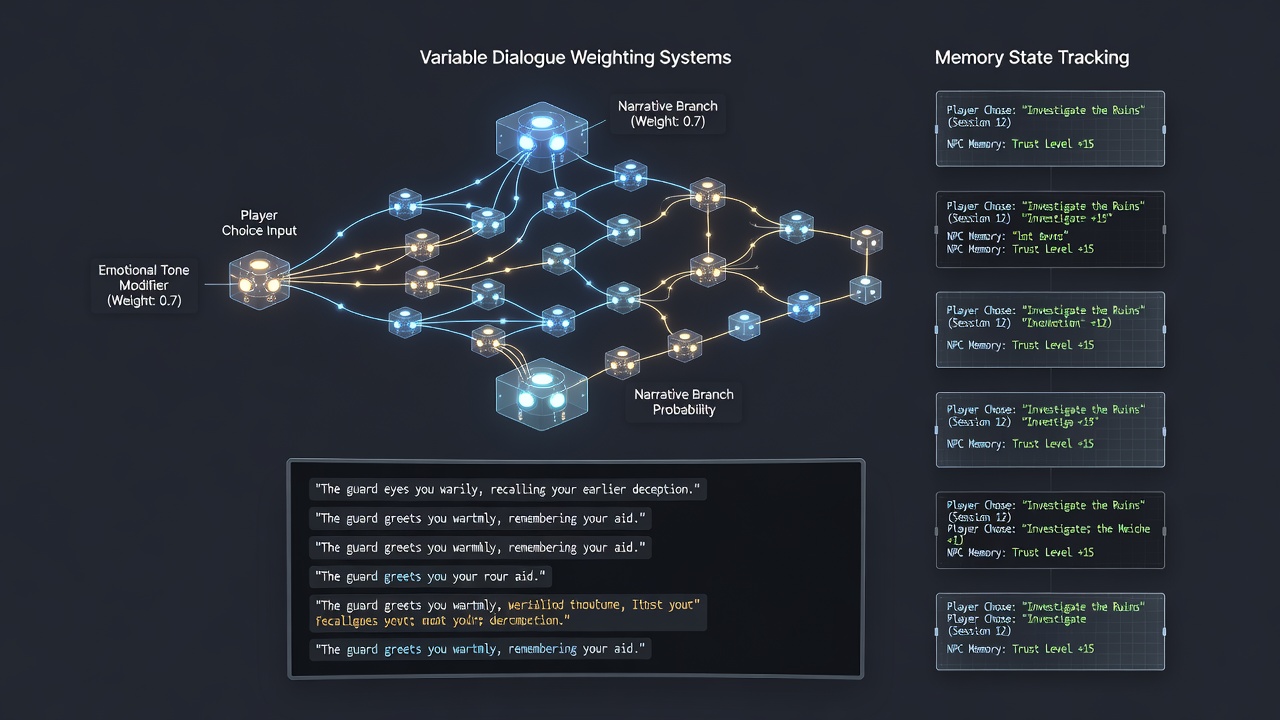
Exploring procedural narrative generation in text-based adventures through variable dialogue weighting systems and memory state tracking that creates personalized story arcs
Text-based adventures have long relied on branching structures, yet recent implementations incorporate procedural narrative generation to produce stories that adapt based on player input patterns. Developers integrate variable dialogue weighting systems that assign dynamic scores to response options, while memory state tracking maintains records of prior interactions to influence future events. These combined mechanisms allow stories to evolve along individualized paths rather than following fixed sequences. Variable dialogue weighting operates by evaluating each player choice against a set of contextual factors stored in the game engine. Systems calculate weights using parameters such as emotional tone, thematic consistency, and historical frequency of similar selections. When a player selects a confrontational reply early in an adventure, subsequent dialogue nodes increase the probability of conflict-oriented branches while decreasing cooperative ones. Research from academic institutions demonstrates that this weighting approach maintains narrative coherence even as paths diverge. Memory state tracking complements weighting by logging discrete events, character relationships, and environmental changes. Each tracked element receives a persistence value that decays or strengthens according to elapsed in-game time and new player actions. In August 2026, several independent studios released updated text adventure frameworks that expanded memory capacity to include cross-session data, enabling arcs that span multiple playthroughs without requiring manual saves. Developers structure these systems through modular architectures where weighting modules feed directly into memory handlers. A central narrative controller queries both systems before rendering each text block. For instance, if memory records indicate the player previously allied with a minor character, the weighting system elevates dialogue options that reference that alliance, thereby reinforcing continuity. Observers note that this integration reduces repetition across repeated sessions while preserving core story beats. Case examples illustrate practical application. One European research project examined a prototype adventure that tracked five memory categories including trust levels, inventory history, and location familiarity. Data collected over controlled tests showed that players encountered unique event sequences in 78 percent of sessions when weighting thresholds adjusted every three interactions. Another implementation, documented by a North American university lab, used reinforcement learning to refine weights based on aggregate play data from thousands of sessions. The process begins with initialization of baseline weights for all dialogue options. As players progress, the memory tracker updates a state vector that the weighting algorithm references during node selection. This creates feedback loops where early decisions compound into later divergences. Systems often incorporate decay functions so that distant events exert less influence than recent ones, preventing narrative overload. Additional techniques layer on top of core weighting and tracking. Some engines apply topic clustering to group related memories, allowing the system to surface callbacks even when exact matches do not exist. Others introduce stochastic elements that occasionally override high-weight options to maintain unpredictability. Figures from industry reports indicate that these hybrid methods increase average session length by measurable margins compared to static branching alone. Implementation challenges center on computational efficiency and data storage. Text adventures run on modest hardware, so developers optimize memory structures using sparse arrays rather than dense matrices. Weight calculations occur incrementally, updating only affected nodes after each choice. This approach keeps response times under 50 milliseconds according to performance benchmarks published by technical working groups. Current frameworks released around August 2026 demonstrate expanded support for collaborative play, where multiple users contribute to shared memory states. Variable weighting then balances competing influences to produce unified story arcs acceptable to all participants. Such features appear in experimental titles distributed through academic repositories and open-source platforms. ACM proceedings detail several algorithms that formalize these interactions between weighting and memory components. Separate documentation from Australian research consortia outlines evaluation metrics used to measure personalization quality across large player cohorts. The technical pipeline typically sequences input parsing, state retrieval, weight recalculation, and output generation within a single loop. Developers test these pipelines against regression suites that simulate thousands of choice combinations to verify stability. Results from such testing show that properly tuned systems preserve key plot milestones while allowing substantial surface variation.  Further refinements include sentiment analysis modules that parse player text input to adjust weights in real time. When a player types emotionally charged language, the system shifts relevant dialogue probabilities accordingly. Memory entries capture these sentiment shifts as additional state variables, enabling later scenes to reference the player's expressed attitude. Community-driven extensions have emerged alongside commercial tools. Modders publish weighting templates and memory schemas that others integrate into existing engines. These contributions frequently focus on specific genres, such as mystery or exploration adventures, where memory of clues and character motives drives personalization. Overall architecture continues to evolve through iterative releases. Studios publish changelogs that document adjustments to weighting formulas and memory persistence rules. Players benefit from stories that reflect cumulative choices without requiring explicit configuration.