Unraveling Chain Reaction Mechanics in Destructible Environment Games Through Object Property Cascades
Written by Devon Schmid · Jun 5, 2026
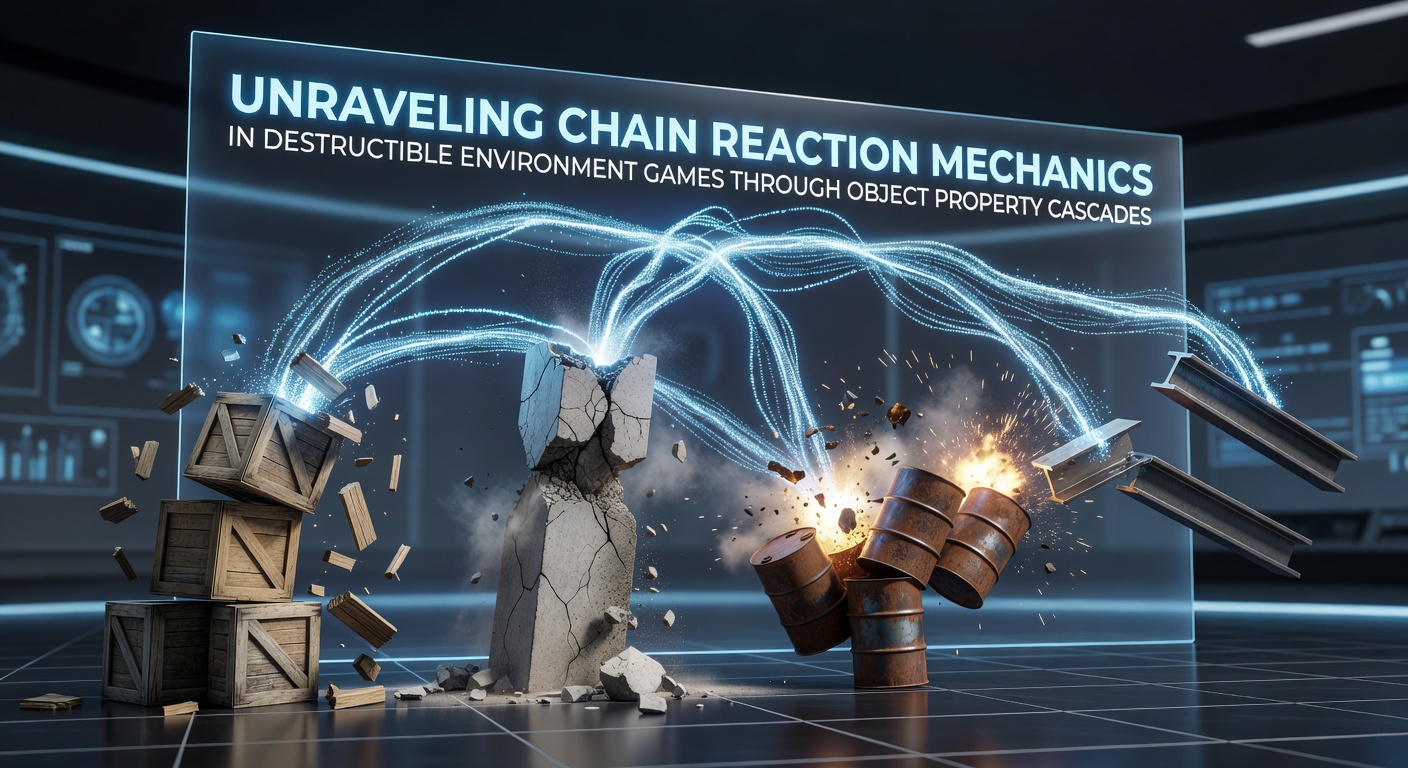
Unraveling Chain Reaction Mechanics in Destructible Environment Games Through Object Property Cascades
Developers design destructible environments by assigning discrete properties to individual objects so that interactions between them produce predictable yet emergent chain reactions and these properties include factors like flammability thresholds, structural mass values, conductivity ratings, and explosive potential that activate sequentially when one object reaches its failure point.
Core Mechanics of Property Assignment
Game systems assign each environmental element a set of attributes that determine how it responds to external forces while neighboring objects inherit influence through proximity checks and shared simulation layers; research from institutions like the University of Waterloo indicates that layering these attributes allows for controlled cascades where a single initial event propagates outward based on predefined relational rules rather than random chance.
Properties operate on numerical scales so that temperature accumulation on one object can exceed its ignition value and transfer heat to adjacent materials until a full sequence unfolds and this approach creates opportunities for players to manipulate outcomes by targeting specific weak points in the chain.
Trigger Conditions and Propagation Logic
Cascades begin when an object meets its activation criteria such as receiving sufficient impact force or exposure to an elemental effect and from that moment the engine evaluates connected objects in successive frames to apply matching property changes; according to data compiled by the Interactive Software Federation of Europe these evaluations occur at rates exceeding 60 per second in modern titles to maintain visual coherence during rapid sequences.
Propagation follows graph-based models where objects form nodes and shared edges represent potential transfer paths so that a falling support beam might increase load on connected platforms until their integrity values drop below zero and initiate further collapses; the system recalculates these connections dynamically whenever the environment state updates.
Engine Implementation Strategies
Physics engines integrate property cascades through modular components that separate simulation logic from rendering pipelines and this separation allows designers to tweak cascade thresholds without rebuilding entire levels; updates released in June 2026 by major middleware providers expanded support for multi-threaded property evaluations which reduced frame drops during large-scale destructions in tested builds.
Developers often combine rigid body dynamics with particle systems so that when one object ignites the resulting heat map influences nearby entities in real time and this combination produces layered effects where visual feedback aligns closely with underlying mechanical rules.
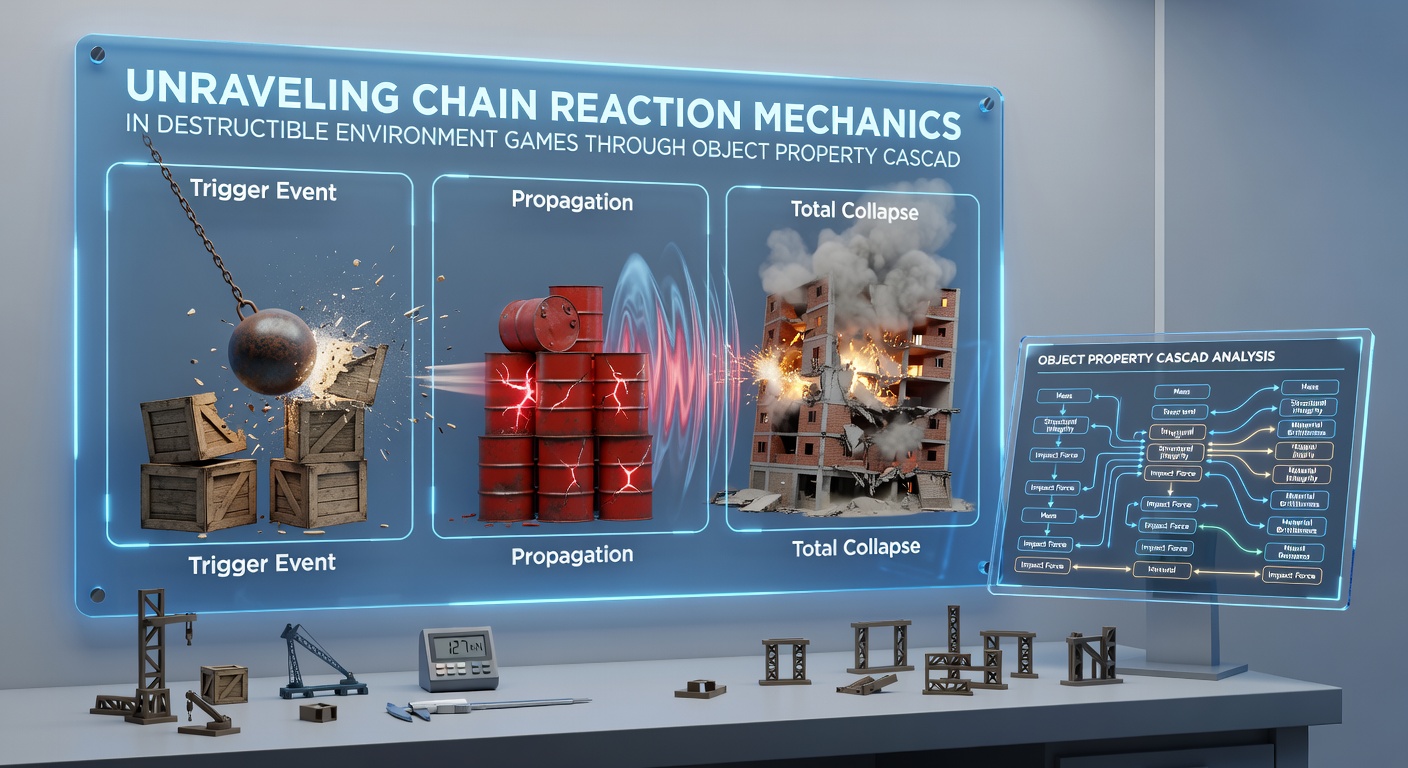
Performance optimizations include spatial partitioning techniques that limit checks to objects within defined radii and these methods prevent exponential growth in computational load during extended chain events; industry reports show that titles employing such optimizations achieve stable frame rates even when hundreds of objects participate in a single cascade sequence.
Observed Patterns Across Game Titles
Analysis of released titles reveals recurring patterns where property cascades serve both gameplay progression and environmental storytelling and one common approach involves using conductivity properties to link electrical systems so that disabling one component deactivates or overloads distant elements in sequence.
Another pattern centers on mass and momentum transfers where initial destruction alters gravitational forces on stacked elements and triggers secondary falls that follow logical paths determined by object shapes and connection strengths; observers note these patterns appear consistently across genres that emphasize environmental interaction.
Technical Challenges and Solutions
Balancing cascade predictability against player agency requires careful calibration of property values so that outcomes feel responsive without becoming entirely deterministic and teams address this through iterative testing cycles that log thousands of interaction variants per build.
Network synchronization presents additional hurdles in multiplayer contexts because each client must resolve the same cascade sequence without divergence and solutions include authoritative server calculations that broadcast final states rather than individual property changes; a 2025 study conducted by researchers at Aalto University in Finland examined these synchronization methods across several European-developed titles and confirmed measurable reductions in desync incidents when property updates were batched.
Future Directions in Cascade Design
Emerging techniques explore machine learning models that adjust property relationships based on player behavior patterns and these models analyze session data to refine cascade probabilities while preserving core mechanical consistency; early implementations appear in experimental builds shared at industry events scheduled for later in 2026.
Integration with procedural generation tools further extends these systems by allowing environments to inherit property sets automatically from seed values and this reduces manual setup time while maintaining the relational integrity needed for coherent chain reactions.
Conclusion
Object property cascades form the foundation for chain reaction mechanics in destructible environment games and their implementation through layered attributes and propagation logic enables complex interactions that respond to player actions in structured ways; continued refinement of these systems supports both technical performance and design flexibility across current and upcoming releases.